The Real Risks of Leg Lengthening, in the Order They Actually Happen
The risk lists on clinic websites are usually correct and almost useless. Infection, nerve injury, blood clots, non-union — true, but presented as a flat list with no sense of when each one strikes, how often, what it takes to fix, or who has to be in the room when it does.
Surgeons do not think about it that way. They sort risk into tiers by how much it costs to resolve, and they map it onto the phases of treatment, because a problem in week two and the same problem in month five are different problems. Once you can read the risks the way a limb reconstruction surgeon reads them, you can tell a serious consent conversation from a reassuring one — and you can see why two quotes with similar headline figures may be pricing very different amounts of risk.
General information, not medical advice. Only an orthopaedic surgeon who has examined you and your X-rays can assess your individual risk.
First, the Honest Baseline
The largest systematic review of cosmetic stature lengthening, published in Bone & Joint Research in 2020, pooled 11 studies and 795 patients. Mean gain was 6.7 cm; mean follow-up was 4.9 years. The authors used the three-tier classification most limb reconstruction surgeons use:
- Problems — difficulties that resolve without an operation. Mean 0.78 per patient.
- Obstacles — difficulties that need a procedure to resolve. Mean 0.94 per patient.
- Complications — permanent or serious consequences. Mean 0.15 per patient.
So the average patient in the published literature had roughly two events that needed someone’s attention, and about one in seven had something that counted as a true complication. The most common problem and obstacle was ankle equinus; the most common complications were deformation of the new bone after treatment ended and subtalar joint stiffness.
The authors’ conclusion had two halves. The first: outcomes are favourable, satisfaction is high, and the rate of major complications is low. The second, which clinics rarely quote: “Clear indications, contraindications, and guidelines for cosmetic stature lengthening are needed.” In plain terms, the field has not yet agreed who should and should not have this operation. That judgement is currently being made by the centre that will be paid to perform it.
A 2025 review in the Journal of Orthopaedic Surgery and Research reached a similar position: good results in specialist hands, a literature made mostly of small retrospective series, and a real need for standardised reporting. If you are being quoted confident success percentages, ask which study they come from.
Risks During and Immediately After Surgery
The operation involves cutting both femurs (or tibias) and inserting hardware into the marrow canal. The early risks are the ones any major orthopaedic surgery carries, sharpened by the fact that you are having two bones done at once:
- Fat embolism. Reaming the femoral canal can push marrow fat into the bloodstream. It is uncommon and usually mild, but it is one reason you are monitored closely in the first days rather than discharged to a hotel.
- Blood loss and transfusion. Bilateral femoral surgery is not a minor procedure.
- Venous thromboembolism. Major lower-limb surgery plus reduced mobility plus, for many patients, a long-haul flight on either side. Prophylaxis should be prescribed for weeks, not days, and continued after you leave.
- Infection. Deep infection around an intramedullary nail is rare but serious, because the implant itself becomes the problem and may need to come out. With LON, the external pins add a second, more common route: pin-site infection, which is usually superficial and treatable but needs daily care.
- Intraoperative fracture or malposition of the nail, which may need correction before you leave theatre.
Risks During Distraction — Where Most of the Events Happen
This is the two-to-three-month phase in which the bone is lengthened by around a millimetre a day, and it is where the majority of problems and obstacles occur. Bone lengthens on schedule. Soft tissue does not, unless it is made to.
- Joint contracture. The calf muscles pull the foot into a pointed position (equinus); the hamstrings and iliotibial band pull the knee into flexion or limit its bend. This is the single most common event in the literature, it is largely preventable with daily specialist physiotherapy and splinting, and it becomes surgical if it is missed.
- Nerve irritation or injury. Nerves stretch slowly or not at all. Tingling, numbness or weakness, usually in the foot, is a signal that distraction may need to slow or pause. Persistent deficits are uncommon but life-altering, and the difference is usually timing.
- Joint subluxation. Rare with femoral lengthening, more of a concern with larger gains and with the tibia, where the ankle and knee can be pulled out of their normal relationship.
- Premature consolidation. The bone heals across the gap before lengthening is complete, which can require another osteotomy.
- Poor regenerate. The opposite problem: the new bone forms slowly or thinly, which may mean slowing the rate, adding bone graft or marrow, or prolonging consolidation.
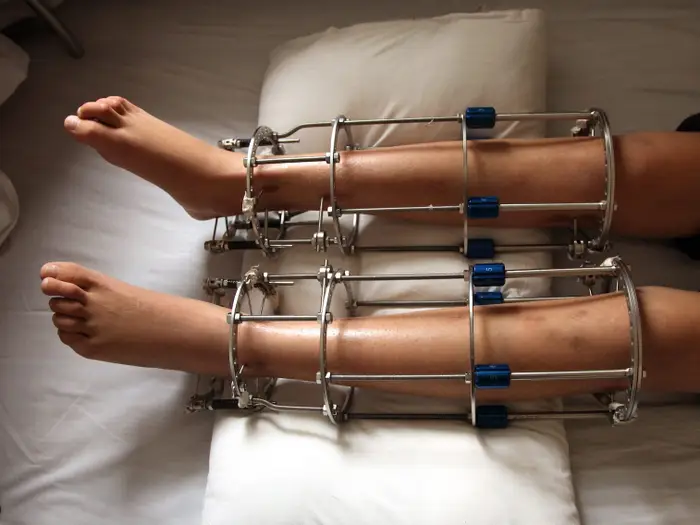
- Device failure. Nail breakage, a motor that stops lengthening, or with LON a frame component that loosens. Each is an unplanned procedure.
- Distraction rate errors. Too fast and you stress nerves and regenerate; too slow and you risk premature consolidation. Precision varies by device — a comparison of femoral lengthening methods from the Hospital for Special Surgery found the magnetic internal nail more accurate than LON and associated with fewer complications.
Almost every item in that list has the same structure: detectable early, manageable if detected, costly if not. That is why the stay-or-go-home question is a risk question before it is a budget question.
Risks During Consolidation and After
Once you are at target length, the new bone has to harden enough to carry you. Months pass. Several of the most serious events happen here, often after patients have gone home.
- Delayed union or non-union. The regenerate does not mature; weight bearing stays restricted; further surgery may be needed.
- Regenerate fracture or deformation. The most common true complication in the 795-patient review — new bone bending or breaking after treatment ended, typically because weight bearing was advanced before the bone could take it, or because the implant was removed too early.
- Stiffness that outlasts the treatment. Particularly at the subtalar joint and knee, if contractures were not fully resolved during distraction.
- Implant-related problems. The stainless-steel Precice Stryde nail was withdrawn in 2021 after reports of pain, bone erosion and corrosion at its telescoping junction; patients who still have one are advised to be monitored until removal. The titanium Precice was not affected. The lesson is not that nails are dangerous — it is that you should know exactly which implant is in your bones, by manufacturer, model and lot number, and keep that document for life.
- The removal operation, usually a year or more later, which carries its own small risks and has to happen somewhere.
The Risks Nobody Classifies
Two things sit outside the surgical literature and inside most patients’ actual experience.
Function. Lengthening changes the mechanics of muscles that evolved at a different length. Most people regain normal walking and daily function; fewer regain their pre-operative sprint speed or jumping ability, and the larger the gain, the more likely a permanent trade-off. If you play sport seriously, this deserves a direct conversation.
Expectation. The operation changes the length of your bones. It does not change how you feel about yourself, and for some people the focus simply migrates after recovery. A centre that requires or offers a psychological assessment before booking is protecting you, not gatekeeping.
Why This Is Also a Question About Money
Anyone who has typed limb lengthening surgery Turkey price into a search bar has seen how widely the figures vary, and most people assume the spread reflects quality or margin. Often it reflects risk allocation. One quote includes daily physiotherapy for the entire distraction phase, weekly imaging, a written protocol for pausing distraction, the removal operation, and a revision policy. Another includes the operation and a hotel. The risks above do not disappear from the cheaper quote; they are simply transferred to you and to whichever health system you go home to.
So when you compare, compare what happens if a contracture develops in week six, if a nail stops lengthening, if the regenerate is slow. A limb lengthening surgery Turkey price that answers those questions in writing is a different product from one that does not, whatever the headline figure.
Questions to Get Answered in Writing
- How many bilateral femoral lengthenings does my named surgeon perform a year?
- What are your own rates of nerve injury, contracture requiring surgery, premature consolidation and non-union?
- Which implant, exactly, and will I receive its identification details before discharge?
- What is the protocol if distraction needs to slow or stop, and who decides?
- How much physiotherapy is included, delivered by whom, and what is the plan at home?
- What clot prophylaxis will I receive, for how long, and who monitors it after I fly?
- Who do I contact about a complication in month four, and who pays for the revision?
The most informative answer is usually to question two. A surgeon who knows their own numbers has counted them. One who quotes the literature has not.
Sources and further reading:
- Marwan Y et al. Cosmetic stature lengthening: systematic review of outcomes and complications. Bone & Joint Research 2020: https://pmc.ncbi.nlm.nih.gov/articles/PMC7342054/
- Aesthetic lower limb lengthening techniques: a systematic review of efficacy, complications, and patient satisfaction. Journal of Orthopaedic Surgery and Research 2025: https://link.springer.com/article/10.1186/s13018-025-05808-x
- International Center for Limb Lengthening, patient alert on the Precice Stryde recall: https://www.limblength.org/recalls/precice-stryde-plate-and-bone-transport-systems-recall/
- Live Taller Now, limb lengthening surgery in Turkey (procedure overview and patient pathway): https://livetallernow.com/limb-lengthening-surgery-turkey/