Partial or Total Knee Replacement? Your Knee Answers Most of It
“Which is better” is the wrong question, and it is worth understanding why before you read a single comparison table.
A partial knee replacement is not a smaller version of a total. It is a different operation for a different knee: one in which the arthritis is confined to a single compartment, the ligaments are intact and the deformity is correctable. If that describes your knee, the evidence says the two operations give you similar function at five and ten years, with the partial recovering faster and carrying a somewhat higher chance of needing further surgery. If it does not describe your knee, a partial is not an option, and no amount of preference changes that.
So the decision splits into two questions. Is my knee eligible? And if it is, who should do it? The second question turns out to matter as much as the first.
General information, not medical advice. Only an orthopaedic surgeon who has examined you and your imaging can tell you which operation is appropriate.
What the Two Operations Actually Do
A total knee replacement resurfaces all three compartments — the inner and outer halves of the joint between femur and tibia, and the kneecap joint — with metal and polyethylene. The anterior cruciate ligament is removed, and in most designs the posterior cruciate is removed or substituted.
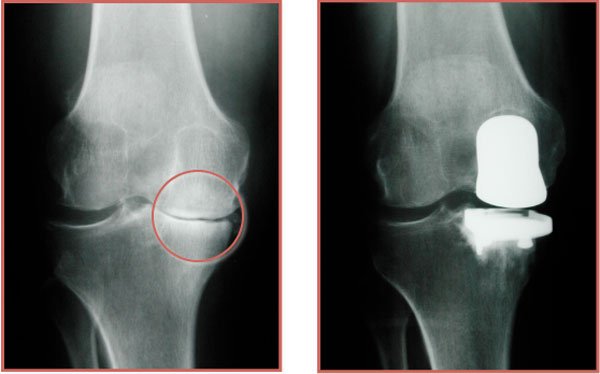
A partial (unicompartmental) knee replacement resurfaces only the worn compartment, almost always the inner one, through a smaller incision. Both cruciate ligaments are kept, which is why the knee tends to feel more natural and bends further afterwards.
That preservation is the whole trade-off. Keeping your ligaments gives you a knee that moves like your own. It also means the rest of your joint is still your own — and can still wear out.
Is Your Knee Eligible?
The classic criteria for a medial partial replacement are: arthritis with bone-on-bone contact confined to the inner compartment; a functioning anterior cruciate ligament; a deformity that corrects when the surgeon examines you; and a reasonable range of movement. Inflammatory arthritis, significant disease in the outer compartment, and an absent cruciate generally rule it out.
How many people qualify? More than you might expect. Studies of knee arthroplasty populations have estimated that somewhere between a quarter and nearly half of patients could be candidates for a partial, yet in most national registries partials make up roughly a tenth of knee replacements. That gap is not because patients are choosing totals. It is because most surgeons do very few partials, and a surgeon who does few tends to offer few.
Which brings you to the evidence.
What the Best Trial Says
The Total or Partial Knee Arthroplasty Trial (TOPKAT) randomised patients with isolated medial arthritis across 27 UK centres and published five-year results in The Lancet in 2019. There was no difference in the Oxford Knee Score between the groups. Re-operation and complication rates were similar, with complications somewhat more frequent after totals. The partial was also less expensive over five years and delivered more quality-adjusted life years, which made it the more cost-effective option.
Ten-year follow-up, published in The Lancet Rheumatology in 2026, held the line: outcomes remained broadly similar, with partials carrying slightly lower costs and slightly better quality of life.
That is the case for the partial, from the best evidence available, in eligible patients.
Why the Registries Disagree With the Trial
Here is the complication. National joint registries — which record real-world practice rather than trial conditions — consistently show partials being revised more often. The registry for England, Wales, Northern Ireland and the Isle of Man reports five-year revision rates of around 2.65% for total replacements and 6.11% for partials. Registries are not wrong, and neither is the trial. They are measuring different things.
The resolution lies in who is operating. An analysis of 41,986 partial knee replacements from the same registry found that revision rates depend heavily on what proportion of a surgeon’s knee practice is partials. Surgeons who used the partial in 20% or more of their knee replacements achieved acceptable results; those using it in 40 to 60% achieved the best. Surgeons with the lowest usage — partials making up 5% or less of their knee work — had the highest revision rates. With optimal usage and the most common implant, five-year survival was about 96%; with the low usage once considered ideal, it was about 90%.
Now look at who meets that bar. A study of 3,037 knee surgeons across the UK, Australian and New Zealand registries found that more than half performed partials in fewer than 5% of their knee replacements, and only about 11 to 16% met the recommended usage thresholds. TOPKAT surgeons were, by design, experienced in the procedure. The registries include everyone.
So the revision gap is real, and it is mostly a surgeon-experience gap. A partial done by someone who does them constantly performs close to the trial. A partial done by someone who does a handful a year performs like the registry average, or worse.
What This Means If You Are Travelling for Surgery
If you have been comparing knee replacement Turkey cost figures against quotes at home, the evidence above rearranges what you should be comparing.
The first thing to establish is not the price; it is which operation you are a candidate for. That requires weight-bearing X-rays, a proper examination of your ligaments and deformity, and ideally an MRI if the other compartments are in doubt. A quote issued before anyone has done that is a quote for an operation nobody has chosen yet.
The second is the surgeon’s partial-knee usage. Ask directly: of your knee replacements in the last year, how many were partials? If the answer is a handful, and you are eligible for a partial, that surgeon is a fine choice for a total and a poor choice for a partial — wherever they practise.
The third is what happens afterwards. Partials are revised more often than totals in the real world, and revision usually means conversion to a total. That is a routine operation in experienced hands, but it has to happen somewhere, years later, with your records available. Ask for the implant brand, model and lot number in writing before you leave, along with operation notes and post-operative X-rays, and ask what your own orthopaedic service will need if it inherits your knee.
Fourth, the logistics that are identical for either operation: clot prophylaxis that continues for weeks after discharge, a written clearance to fly, and a named contact for problems in week three.
How the Choice Usually Lands
Without making it for you:
A partial makes sense if your arthritis is confined to one compartment with intact ligaments, you value range of movement and a natural-feeling knee, you accept a higher chance of further surgery later, and — crucially — your surgeon performs partials as a substantial, routine part of their practice.
A total makes sense if your disease involves more than one compartment, your ligaments are compromised, you have inflammatory arthritis, or the only experienced surgeon available to you is experienced in totals.
Neither is “better.” One is right for your knee, and the trial says that in the right knee, in the right hands, they serve you about equally well.
Questions to Get Answered in Writing
- Based on my imaging and examination, am I a candidate for a partial — and if not, which criterion rules it out?
- How many knee replacements did you perform last year, and what proportion were partials?
- What implant will you use, and will I receive its identification details before discharge?
- What are your own five-year revision rates for each operation?
- What clot prophylaxis will I be on, for how long, and who supervises it at home?
- When am I cleared to fly, and who reviews me at six weeks and one year?
- If this knee needs revising in eight years, what documentation will the surgeon who does it need from you?
A knee replacement Turkey cost comparison only becomes meaningful once those seven answers sit beside each quote. Until then you are comparing numbers attached to operations that have not been chosen, performed by surgeons whose caseload you do not know.
Sources and further reading:
- Beard DJ et al. The clinical and cost-effectiveness of total versus partial knee replacement (TOPKAT): 5-year outcomes of a randomised controlled trial. The Lancet 2019: https://pubmed.ncbi.nlm.nih.gov/31326135/
- Beard DJ et al. Assessing clinical and cost effectiveness of total versus partial knee replacement (TOPKAT): 10-year follow-up. The Lancet Rheumatology 2026: https://www.sciencedirect.com/science/article/pii/S2665991325002504
- Liddle AD et al. Optimal usage of unicompartmental knee arthroplasty: a study of 41,986 cases from the National Joint Registry. The Bone & Joint Journal 2015: https://boneandjoint.org.uk/Article/10.1302/0301-620X.97B11.35551
- Live Taller Now, knee replacement surgery in Turkey (procedure overview and patient pathway): https://livetallernow.com/knee-replacement-surgery-turkey/