The 2026 Business Guide to Upgrading Commercial Properties with Solar PV and EV Infrastructure
The Strategic Shift: Why Commercial Facilities Must Modernize Energy Infrastructure
The commercial real estate landscape is undergoing a fundamental transformation driven by the urgent need for decentralized energy generation. Rising grid electricity costs continue to compress operational margins, compelling facility managers to seek predictable, long-term energy solutions. Transitioning to independent renewable energy architectures is no longer just an alternative; it is a core business strategy.
Beyond cost mitigation, stringent ESG (Environmental, Social, and Governance) compliance mandates are reshaping corporate accountability. Stakeholders and institutional investors increasingly demand transparent operational sustainability. Modernizing facility infrastructure directly addresses these pressures by drastically reducing Scope 2 greenhouse gas emissions.
Ultimately, integrating on-site renewable energy aligns directly with corporate carbon neutrality targets. By transforming static commercial properties into dynamic energy assets, enterprises can future-proof their operations against market volatility while meeting rigorous international environmental standards.
Core Infrastructure: Safeguarding Commercial Solar PV Systems
When upgrading commercial facilities with large-scale solar arrays, system safety and high-voltage power distribution efficiency must be the foundational priority. According to electrical engineering standards, integrating a commercial-grade smart solar combiner box is critical to safely aggregate the power output from multiple PV strings while offering essential protective features like rapid shutdown and arc fault circuit interruption (AFCI). Utilizing robust PV protection solutions from industry-leading manufacturers like BENY ensures that the photovoltaic architecture operates within strict international safety compliance, effectively mitigating fire risks on commercial rooftops.
Understanding the inherent risks of direct current (DC) is paramount for facility managers. Unlike alternating current (AC), high-voltage DC generated by solar panels does not have a zero-crossing point, making it highly susceptible to sustained electrical arcing. Protecting the DC side of a solar array is therefore vastly more critical than the mere installation of photovoltaic modules.
A compromised DC infrastructure can lead to catastrophic thermal events. Comprehensive safeguarding requires precision-engineered isolating switches, surge protection devices (SPDs), and continuous circuit monitoring to isolate faults before they escalate into facility-threatening fires.
The Critical Role of Solar Combiner Boxes and Rapid Shutdowns
From an electrical engineering perspective, smart combiner boxes serve as the central nervous system for commercial solar arrays. They efficiently consolidate multiple DC inputs from PV strings into a unified output, minimizing power loss while housing essential overcurrent protection.
In parallel, Rapid Shutdown (RSD) devices are non-negotiable life-safety mechanisms. In the event of an emergency, these devices instantly de-energize the entire DC array at the module level. This capability is vital for protecting first responders and firefighters from lethal high-voltage exposure.
To maintain compliance with UL 1741 and NEC 2023/2026 standards, your PV protection framework must include:
- Module-level de-energization to drop voltage below 30V within 30 seconds of grid failure.
- Advanced AFCI integration to detect and interrupt microscopic arc signatures before combustion.
- Type 1/Type 2 Surge Protection Devices (SPDs) to deflect atmospheric lightning and grid anomalies.
- IP65/IP66 rated enclosures to ensure operational integrity under extreme commercial rooftop weather conditions.
Integrating EV Charging Stations for Employees and Fleets
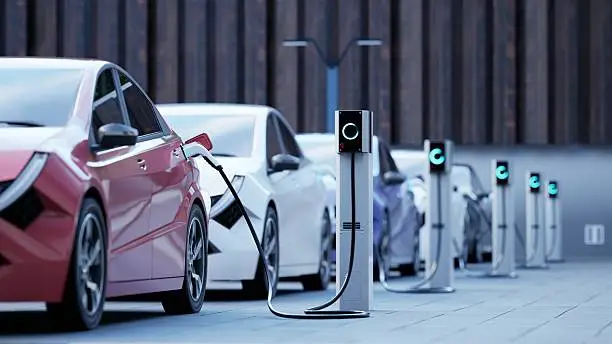
The rapid electrification of commercial fleets and employee vehicles necessitates the deployment of robust on-site EV charging stations. Facilities must strategically balance high-capacity DC fast chargers for rapid fleet turnaround with efficient AC Level 2 chargers for employee daytime parking.
A critical challenge in EV infrastructure deployment is managing the sudden surge in electrical demand. Implementing Dynamic Load Balancing (DLB) technology is essential to prevent facility grid overload. DLB algorithms continuously monitor the building’s real-time power consumption and intelligently distribute available capacity across active EV chargers.
To successfully execute a commercial EV rollout, decision-makers should follow these operational steps:
- Conduct a baseline load profile analysis to determine the facility’s available excess electrical capacity.
- Deploy smart DLB controllers to dynamically throttle charging speeds during peak building operational hours.
- Standardize communication protocols (like OCPP 1.6/2.0.1) for seamless integration with energy management software.
- Phase the installation starting with vital fleet infrastructure, scaling up as demand and capacity allow.
Maximizing ROI with Battery Energy Storage Systems (ESS)
To truly capitalize on the transition to renewable energy, forward-thinking businesses must look beyond solar panels and invest in comprehensive battery energy storage. Storing excess solar energy allows commercial facilities to manage peak load times efficiently and maintain operational resilience during grid outages. In fact, comprehensive global energy transition tracking by the International Energy Agency (IEA) highlights that grid-scale and commercial battery storage capacity is expected to multiply significantly, fundamentally becoming the backbone of decentralized energy grids and corporate net-zero strategies globally.
A commercial Battery Energy Storage System (ESS) dramatically accelerates the project’s Return on Investment (ROI) through sophisticated Peak Shaving. Commercial utility rates often include steep demand charges based on the maximum power drawn during a billing cycle.
By discharging stored battery power during the most expensive, high-demand hours, facilities can effectively flatten their consumption curve. This strategic “time-shifting” of energy not only minimizes punitive utility fees but also maximizes the utilization of self-generated solar power, converting stranded assets into immediate capital savings.
Key Takeaways
| Area | Key Takeaway | Impact/Data |
| Strategy | Upgrade microgrids to reduce costs and meet ESG compliance | Lower Scope 2 emissions and risks associated with market volatility |
| Safety | Mandatory deployment of smart combiner boxes and rapid shutdown devices | Reduce voltage to below 30V within 30 seconds |
| Charging | Deploy dynamic load balancing to prevent grid overload | Real-time monitoring and intelligent power distribution |
| Energy Storage | Utilize battery energy storage systems for peak shaving and valley filling | Accelerate ROI through time-shifting |
Conclusion: Taking the First Step Toward Energy Independence
Achieving absolute energy independence requires meticulous planning and rigorous technical validation. Commercial property owners must avoid ad-hoc installations and instead approach energy modernization as a holistic, integrated engineering project.
The first actionable step is commissioning a comprehensive site electrical load assessment by certified engineers. This audit will reveal the true capacity of existing transformers, switchgear, and distribution panels, ensuring they can handle bidirectional power flows.
Following the load assessment, enterprises must conduct strict qualification reviews of all hardware vendors and EPC (Engineering, Procurement, and Construction) contractors. Verifying IEC/UL certifications and demanding transparent warranty frameworks will guarantee that your modernized facility remains safe, compliant, and highly profitable for decades.