Online vs In-Person Couple Counselling: Which Works Better?
Couple counselling has never been more accessible. Where once it required coordinating two schedules, arranging childcare, and driving to an office — all before the session had even begun — couples can now access professional support from their own living room. The rise of online counselling has opened the door for many couples who might otherwise never have sought help.
But with more choice comes a genuine question: does online couple counselling actually work as well as sitting in a room with a therapist? The answer, as with most things in relationships, is more nuanced than a simple yes or no. The best format depends on the couple, the issues they are navigating, and the practical realities of their lives.
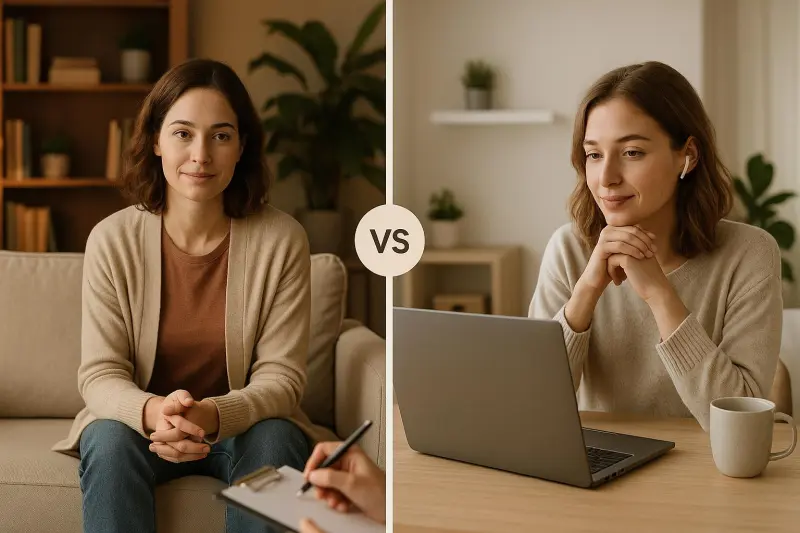
The Case for In-Person Couple Counselling
There is something about being physically present in a counsellor’s office that carries its own therapeutic weight. Couples leave their everyday environment — the kitchen where arguments happen, the living room where silence settles — and enter a neutral space dedicated entirely to the work of their relationship. This separation from daily life can itself signal that something different is happening here.
In-person sessions also give the couple counsellor near me access to a fuller picture of the couple’s dynamic. Body language, physical proximity, eye contact, and the subtle tension in a room are all visible in ways that a screen simply cannot capture.
An experienced counsellor reads these non-verbal cues constantly — noticing when one partner turns away, when voices tighten, or when an unexpected moment of warmth passes between two people. This depth of observation can meaningfully shape how the therapist intervenes.
For couples dealing with high-conflict dynamics, trauma, or deeply entrenched patterns, in-person counselling often provides the containment that the work requires. The physical presence of a trained professional in the room can de-escalate tension in ways that are harder to achieve remotely.
The Case for Online Couple Counselling
Online counselling has moved well beyond a pandemic-era workaround. For many couples, it is genuinely the better option — and research increasingly supports its effectiveness across a wide range of presenting issues.
The most obvious advantage is accessibility. Couples in rural or remote areas, those with demanding work schedules, parents of young children, or partners with mobility challenges can access high-quality counselling that geography or logistics would otherwise put out of reach. Removing these barriers means more couples actually show up — consistently — rather than letting practical obstacles become reasons to disengage.
There is also a comfort dimension worth acknowledging. Some couples find it easier to open up from the familiarity of their own home. The slight distance that a screen provides can reduce the initial self-consciousness of sitting face to face with a stranger and discussing the most vulnerable parts of a relationship. For couples taking their very first step into counselling, this lower barrier to entry can be genuinely significant.
Online counselling also tends to offer greater flexibility in scheduling — including evening and weekend availability that traditional practice hours often do not accommodate. For two working partners trying to find a shared slot, this flexibility is not a minor convenience. It is what makes counselling sustainable over time.
Where Each Format Has Its Limits
Online counselling does have genuine limitations. Poor internet connections, household interruptions, or a lack of private space can all disrupt sessions in ways that undermine the work. Couples sharing a home with children, housemates, or thin walls may find it difficult to speak candidly — which defeats the purpose entirely.
In-person counselling, meanwhile, is not always accessible. Cost, location, waiting lists, and the logistical demands of attending can all create barriers that cause couples to delay seeking help — sometimes until the relationship has deteriorated significantly further than it needed to.
So Which Works Better?
The honest answer is that the research does not clearly favour one format over the other for most couples. What matters far more than the medium is the quality of the therapeutic relationship, the skill of the counsellor, and — most critically — the couple’s consistent engagement with the process.
A useful way to think about it: online counselling removes the barriers that stop couples from starting. In-person counselling by a therapist North Vancouver offers advantages for couples navigating particularly complex or volatile dynamics. Many couples find that a hybrid approach — beginning online for accessibility and flexibility, then moving to in-person sessions for deeper or more intensive work — gives them the best of both.
The Format That Gets You There Is the Right One
If the choice between online and in-person counselling has been a reason to delay seeking support, it is worth setting that deliberation aside. The most important step is not choosing the perfect format. It is deciding to begin. A good counsellor will work effectively with you regardless of the screen between you — or the lack of one.
What transforms a relationship is not where the session takes place. It is what both partners are willing to bring to it.