
SEO Mistakes That Stop Small Businesses From Ranking Higher
Maybe you’ve updated your website, added SEO keywords, and even published a few blog posts. But your rankings haven’t moved, and Google still isn’t sending much organic traffic your way. It’s frustrating, especially when you can’t tell what’s actually wrong.
Most of the time, it comes down to a handful of SEO mistakes that are easy to miss when you’re managing your own website. At https://www.click2rank.com, we help small business owners identify and fix these issues every day. This guide breaks down the most common ones so you can spot them on your own site and know where to start.
But first, let’s see why small businesses run into these problems more than larger ones do.
Why Small Businesses Struggle With SEO
Most small businesses struggle with SEO (Search Engine Optimization) because they’re running it without a clear strategy behind it. They optimize a page here, add a keyword there, but search engines evaluate your whole website as a system. So the effort goes in, but the rankings don’t move.

Part of the reason is limited time and resources. Larger companies often have dedicated marketing teams overseeing SEO. Website owners running smaller operations don’t have that luxury, so SEO problems often remain unresolved while other business priorities take over.
By the time it becomes obvious something’s wrong, the gap between them and their competitors has already grown.
Mistake 1: Targeting Keywords No One Searches For
Most websites we audit have the same problem: they’re optimized around the language the business uses rather than the language customers actually search for. It’s natural for business owners to describe their services using industry terms since they know them inside out.
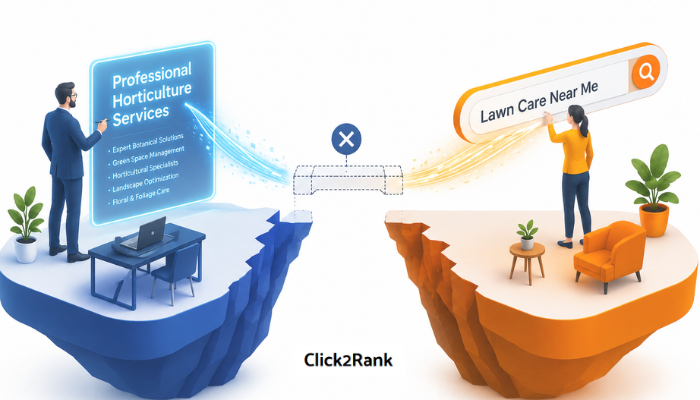
The problem is that potential customers often use completely different phrases when searching online. A landscaping company in Phoenix, for example, might optimize its website around “professional horticulture services.” Meanwhile, local customers are searching for “lawn care Phoenix” or “backyard cleanup near me.”
Both phrases describe similar services, but only one reflects actual search behavior. When a website is built around terms that few people use, it’s far less likely to appear for the searches that generate traffic and leads.
Keyword research takes the guesswork out of this. Tools like Google Search Console show exactly what phrases people type before landing on a site. That makes it much easier to close the gap between business language and actual search behavior.
Mistake 2: Ignoring Local SEO Entirely
Getting your keywords right helps, but for most small businesses, the more important battle is local. Say, a dental practice in Austin or a plumber in Seattle doesn’t need to rank nationally. They need to show up when someone nearby is looking for exactly what they do.
Local SEO makes that possible. It helps search engines connect nearby customers with businesses that offer the products or services they’re looking for. A complete Google Business Profile, local citations, and location-based keywords help your business appear in those results.
A website that ranks well in general search can still be invisible to nearby customers if those local signals aren’t in place. If a competitor appears in search results for “emergency plumber Seattle” and your business doesn’t, they’re far more likely to receive the call. Over time, that can translate into a steady flow of customers choosing a competitor instead.
Mistake 3: A Slow or Mobile-Unfriendly Website
A site can look professional and still underperform where it counts, and page speed is often where that gap shows up first. Google’s mobile speed research found that 53% of mobile visits are abandoned when a page takes longer than three seconds to load. That’s more than half your potential visitors leaving before they’ve seen what you offer.
Page speed and mobile usability also influence search visibility. A slow or difficult-to-use website creates a poor experience for visitors, which hurts both rankings and conversions. Fortunately, many of the most common issues are simple to fix. The table below breaks them down:
| Issue | What It Affects | Quick Fix |
| Slow load times | Rankings, user experience, conversions | Compress images, remove unused plugins, enable caching |
| Poor mobile optimization | Mobile rankings, usability | Use a responsive design, test key pages on different devices |
| Large image files | Page speed | Resize and compress before uploading |
| Too many plugins or scripts | Load times | Remove unnecessary plugins, defer non-essential scripts |
None of these issues requires a complete site rebuild. In many cases, the first step is simply identifying what’s slowing the site down. Tools such as Google PageSpeed Insights can help pinpoint the areas that need attention.
Mistake 4: Publishing Content That Doesn’t Match Search Intent
Many small business owners publish content regularly and still see little traction. The content may be well-written, cover the topic thoroughly, and target the right keywords. But if it doesn’t match what the searcher is trying to achieve, Google is unlikely to rank it well.
The missing piece is search intent: the goal behind a search query. Someone searching for “best accounting software” is comparing options. A search for “emergency plumber Seattle,” by contrast, usually comes from someone who needs help right away. A landing page that misses those expectations is unlikely to outrank pages that better match what the searcher wants.
And when people don’t find what they’re looking for, they return to the search results and choose another page. That signals to Google that the page isn’t delivering, which pushes it down in favor of one that does.
You can avoid this by checking what already ranks for your target keyword before you write. Those pages tell you the format, angle, and depth people expect.
Mistake 5: No Internal Linking Strategy
Every page should point somewhere useful. Yet on many small business websites, important pages sit in isolation, with no clear path guiding visitors or search engines toward them.
Internal links connect those pages. They help visitors discover related content and move through the site more easily. They also help search engines understand how your site is structured and which posts carry the most weight. Without those connections, important pages can struggle to gain traction in search even when they cover the topic thoroughly.
In practice, a simple internal linking strategy usually looks like this:
- Service pages link out to the blog posts that support them
- Anchor text describes the destination instead of saying “click here”
- Related topics connect across the site instead of sitting in isolation
- Links point traffic toward the pages that drive revenue
Done consistently, internal linking helps search engines understand how pages relate to one another and which content deserves attention. It also makes the site easier to navigate, so visitors discover more of your content instead of leaving after a single visit.
Mistake 6: Skipping Title Tags and Meta Descriptions
Your title tag is the headline that appears in search results, and it helps both search engines and users understand what a page is about. Yet many small business websites leave title tags blank, rely on automatically generated versions, or use page titles too vague to attract clicks.
The difference a specific title makes is easier to see than explain:
Weak: “Home Services”
Stronger: “Emergency Plumbing Services in Seattle | Available 24/7”
The stronger title tells Google exactly what the page covers and gives searchers a clear reason to click. If multiple pages share the same title tag, search engines have a harder time identifying which one best fits a given search.
Meta descriptions carry similar weight. They aren’t a direct ranking factor, but they’re often the first thing people read before deciding which result to choose. A clear, relevant meta description can improve click-through rates by setting the right expectations. Left blank, Google generates one automatically, often using text that isn’t the best introduction to your page.
Mistake 7: Expecting Results Too Soon
SEO doesn’t work like an ad campaign, where results can shift almost immediately when you increase your budget. A new SEO strategy typically takes 3 to 6 months before rankings begin to improve. For business owners used to faster marketing feedback, that timeline can feel like a long time.
That’s why many businesses give up too early. It’s common to lose patience after a month or two, even though search engines may still be crawling your updates and evaluating your content. Pulling back at that point means the work already done never gets the chance to show up in search.
We’ve worked with small businesses on SEO long enough to see this happen repeatedly. Sites can sit on page three for months before a content update or a few technical fixes finally move them higher. SEO progress rarely happens in a straight line, which is why judging results too early can be misleading.
Fixing These Mistakes Starts With One Change at a Time
None of these mistakes needs fixing in the same week. Trying to tackle all of them at once usually burns out whoever’s doing the work before results have a chance to show up. Pick the one costing the most, often local SEO or site speed, and start there.
That said, getting a clear picture of where your site stands isn’t always easy on your own. Click2Rank works with small businesses to identify what’s holding their site back across keyword targeting, technical SEO, and content.
Chat to us about where your site stands right now.