Christopher Nolan: The Unknown Stories Behind His Remarkable Career
Christopher Nolan has built a career from contradictions. He directs some of the most expensive films ever made, yet he works with methods that often seem deliberately old-fashioned. His stories bend time, question memory and travel across galaxies, but his sets depend on physical objects, film stock and careful rehearsal. He avoids social media, rarely discusses his family and does not promote a celebrity lifestyle. At the same time, his name alone can turn a difficult subject such as theoretical physics or nuclear history into a global cinema event.
Nolan’s public image can make him appear remote, almost like one of the secretive architects in his films. The reality is more practical. His habits developed through years of making films without money, access or industry backing. His loyalty to the cinema experience comes from childhood encounters with large screens. His complicated narratives reflect an education in literature as much as an interest in technology. Behind the severe suits and guarded interviews stands a filmmaker who has spent most of his life solving the same problem: how can an ambitious idea become something an audience can see, hear and feel?
The Child Who Built Films Before Entering the Industry
Christopher Edward Nolan was born in London on 30 July 1970 to an English father and an American mother. His childhood included time in Britain and the Chicago area, giving him a connection to both countries long before he became a British-American filmmaker. That movement between places did not produce a simple autobiographical theme, but it helps explain why unfamiliar cities, divided identities and displaced characters appear so often in his work.
Nolan started using a camera at eight. His father’s Super 8 equipment became a tool for stop-motion experiments, miniature action and homemade stories. The release of Star Wars had a particularly strong effect on him. Rather than treating cinema as distant entertainment, he tried to reproduce its methods with the materials available at home. Toys became actors, domestic spaces became sets and editing became a practical puzzle rather than an abstract idea.
Large-format cinema also caught Nolan’s attention early. As a teenager, he watched IMAX documentaries at Chicago’s Museum of Science and Industry. The screen’s scale and visual detail remained with him. Decades later, he would help push IMAX cameras beyond documentary and occasional action use, first integrating them into major dramatic features and eventually shooting an entire feature in the format. His commitment did not begin as a marketing strategy. It came from a formative belief that scale can change how an audience responds to an image.
Nolan did not attend film school. He studied English literature at University College London, partly because he wanted an academic subject outside cinema and partly because UCL had useful filmmaking facilities. The choice shaped his work in ways that a technical programme might not have done. Literature trained him to examine viewpoint, structure, ambiguity and the reliability of a narrator. Those interests later became central to Memento, The Prestige, Inception and Oppenheimer.
University life gave Nolan more than access to cameras. He became involved with the UCL Film Society, where he helped screen 35mm films during term time and used the society’s resources to make 16mm projects. He met Emma Thomas at university, beginning a personal and professional partnership that would anchor his career. Thomas later produced every Nolan feature, managing the practical demands behind films known for unusual scale and risk.
Nolan’s early shorts already displayed his interest in circular logic and trapped characters. Doodlebug, made in the late 1990s, follows an agitated man trying to kill a tiny figure in a grubby room, only to reveal a larger version of the same pattern. The film lasts only a few minutes, but it contains ideas that Nolan kept revisiting: repetition, distorted scale, limited information and a protagonist who misunderstands his place in a system.
These student and independent experiments also taught Nolan to work across departments. He wrote, directed, photographed and edited because there was nobody else to handle every task. That experience created a director who understood how one decision affected another. A complicated shot was not merely a visual wish; it had consequences for lighting, performance, sound, editing time and the production budget.
The Weekend Production That Established His Working Method
Nolan’s first feature, Following, grew from restrictions rather than opportunity. The black-and-white thriller centres on a young writer who follows strangers through London and becomes entangled with a burglar. Nolan made it with friends, limited equipment and a tiny amount of film stock. The crew usually worked on Saturdays because many participants had regular jobs during the week.
Scarcity dictated the production’s rhythm. Nolan rehearsed scenes extensively before exposing the film because every unused take cost money. He relied on available light, borrowed locations and simple staging. Actors often wore their own clothes, while flats, streets and offices replaced constructed sets. The shoot stretched across many months, but the finished film remained compact and controlled.
The experience gave Nolan a principle he retained after budgets grew: preparation creates freedom. He does not treat planning as an enemy of spontaneity. Detailed preparation allows a director to recognise which unexpected moments are useful and which merely waste time. On Following, that distinction protected a small stock of film. On later productions, it helped control thousands of crew members, international locations and intricate action.
The film’s fractured chronology also served a practical purpose. Nolan wanted to create suspense without depending on expensive spectacle, so he arranged information to keep viewers reassessing what they had seen. The structure divided the protagonist’s appearance into recognisable stages, helping the audience navigate jumps in time. This was not complexity for its own sake. Form became the main source of tension.
Following reached festivals and attracted attention, but it did not create an easy route into studio filmmaking. Nolan’s next project, Memento, depended on a concept associated with his younger brother, Jonathan Nolan. Jonathan described a man who could no longer form new memories. Christopher developed the idea into a screenplay while Jonathan wrote the short story “Memento Mori”, producing related works with different structures and details.
Memento turned memory loss into a storytelling system. Colour sequences run backwards, while black-and-white sections move forwards. The two lines eventually meet, placing the viewer inside Leonard Shelby’s uncertainty. Audiences know more than Leonard in some moments and less in others. That unstable relationship creates the film’s central moral question: does Leonard seek truth, or does he construct a purpose he can continue to pursue?
The script initially faced resistance because financiers worried that viewers would reject its structure. Newmarket eventually backed the project, and the modestly budgeted film became a critical and commercial breakthrough. It earned Nolan and Jonathan an Academy Award nomination for original screenplay and established Christopher Nolan as a director who could make formal experimentation accessible to a broad audience.
Nolan then directed Insomnia, a studio thriller starring Al Pacino, Robin Williams and Hilary Swank. The film matters because it proved he could work with major performers and a conventional production structure without losing control of tone. Its linear narrative may appear unusual within his filmography, but its themes were familiar: guilt, compromised perception, sleeplessness and a protagonist whose judgement deteriorates.
The leap from Insomnia to Batman Begins was substantial, yet Nolan approached the superhero film as another problem of credibility. He treated Bruce Wayne’s equipment, training and fear as parts of a physical world. Gotham still had theatrical scale, but the film grounded its fantasy in architecture, military research and criminal systems. That decision changed not only Batman but the wider approach to franchise filmmaking during the following decade.
The Unusual Rules That Govern a Nolan Production
Nolan’s sets operate around concentration. He is widely associated with restrictions on mobile phones, though online versions often exaggerate the policy into a theatrical ban enforced for its own sake. The underlying point is simpler: Nolan dislikes devices that divide attention. He does not carry a smartphone and has spoken about keeping his working process separate from constant electronic communication.
Nolan also prefers to stand close to the camera rather than direct from a distant bank of monitors. He has resisted allowing the “video village” to become the social centre of a set. Staying near the actors and camera gives him a direct view of blocking, movement and performance. It also reduces the delay between observing a problem and correcting it.
Single-camera shooting remains another important habit. Nolan often prefers one carefully chosen viewpoint to several cameras collecting coverage from every direction. Multiple cameras can help with stunts or events that cannot be repeated, but they also force compromises in lighting and composition. A single camera makes each angle deliberate, continuing the discipline he learned when film stock was scarce.
Nolan’s attachment to film is technical as well as emotional. Photochemical film records colour, texture and highlights differently from most digital systems, while large-format negatives hold extraordinary detail. He has worked with cinematographers including Wally Pfister and Hoyte van Hoytema to adapt cumbersome cameras for narrative scenes, handheld work, aerial photography and tight interiors.
Physical effects form the visible side of the same philosophy. Inception used a rotating corridor to throw performers across walls and ceilings. The Dark Knight Rises placed a large section of an aircraft beneath another aircraft for its opening sequence. Dunkirk used real boats, aircraft, coastal locations and carefully constructed replicas. Tenet crashed a real Boeing 747 into a building because the production company calculated that buying and destroying the retired aircraft could compete with the cost of creating the sequence through miniatures and digital work.
Nolan does not reject computer-generated imagery. His films contain extensive visual-effects work, but he prefers to give artists photographed material as a foundation. Digital teams remove rigs, join elements, extend environments and create images that cannot be captured safely. The distinction matters because “practical versus CGI” is too crude. Nolan’s method usually combines both, while placing something tangible in front of the lens whenever possible.
The Trinity test in Oppenheimer demonstrates that approach. Nolan and his team created a combination of large-scale practical explosions, chemical reactions, high-speed photography and layered imagery rather than relying on a standard computer-generated nuclear detonation. The result does not attempt a literal full-sized atomic blast. It translates physical phenomena into a subjective experience built around light, fire, sound and expectation.
Sound plays an equally forceful role. Nolan often treats dialogue as one element within the total mix rather than placing every word above music and effects. That choice has attracted criticism, especially after The Dark Knight Rises, Interstellar and Tenet. Nolan’s position is that cinema can communicate through rhythm, expression, scale and sound pressure as well as perfectly isolated speech. Viewers do not always accept that argument, but the disputed mixes are intentional rather than accidental.
Nolan’s personal appearance reinforces his practical routine. He commonly works in dark jackets, shirts, sturdy shoes and layers suitable for changing weather. The clothes look formal beside ordinary production wear, yet they function like a uniform. A director moving between mud, machinery, offices and restaurant bar stools does not need to spend time deciding what to wear each morning.
Working hours on his productions can also surprise people. Nolan’s films look exhausting, but colleagues have often described organised shooting days rather than endless overtime. He values momentum, brief breaks and clear decisions. A focused day can achieve more than a longer schedule weakened by fatigue, repeated discussion and excessive coverage.
The Close Circle Behind the Image of a Solitary Auteur
Emma Thomas occupies the centre of Nolan’s professional life. Calling her simply his wife understates her role. As producer, she helps turn ambitious scripts into schedules, budgets, crews and agreements. Their company, Syncopy, provides continuity across projects, while Thomas manages relationships between the director’s creative demands and the institutions financing them.
The partnership began before either had industry power. Thomas worked in production and gained experience at Working Title, while Nolan pursued short films and independent projects. Their shared history gave them a common understanding of risk. When later films required unusual formats, practical stunts or complex release plans, Nolan was not presenting those demands to an unfamiliar producer. He was working with someone who understood how his methods had developed.
Jonathan Nolan has also shaped several major projects. He co-wrote The Prestige, The Dark Knight, The Dark Knight Rises and Interstellar, and his original idea helped generate Memento. The brothers share interests in identity, technology, systems and moral uncertainty, but their careers developed separately. Jonathan became a major television creator, while Christopher remained focused primarily on theatrical films.
Nolan’s repeated casting reveals a similar preference for established trust. Michael Caine became his most recognisable recurring actor, appearing in films from Batman Begins through Tenet. Caine’s roles ranged from emotional guide to compromised authority figure, but his presence often gave Nolan’s complicated worlds warmth, wit and directness.
Cillian Murphy followed a longer path to a leading role. Nolan first cast him as Jonathan Crane in Batman Begins after considering him for Bruce Wayne. Murphy then appeared in The Dark Knight, The Dark Knight Rises, Inception and Dunkirk. By the time Nolan offered him J. Robert Oppenheimer, the two had built nearly two decades of professional trust. Murphy’s controlled performance could carry long stretches of close observation without conventional heroic release.
Other actors return because Nolan’s productions demand a specific kind of commitment. Christian Bale, Tom Hardy, Anne Hathaway, Kenneth Branagh and Matt Damon have each worked with him more than once. The sets may be secretive and physically demanding, but performers receive carefully built worlds, precise scripts and a director who understands how their work will fit the final structure.
Technical collaborators form another long-term network. Wally Pfister photographed Nolan’s films from Memento through The Dark Knight Rises, helping establish the sharp, high-contrast visual identity of his early and middle career. Hoyte van Hoytema then expanded Nolan’s use of large-format photography on Interstellar, Dunkirk, Tenet, Oppenheimer and later work.
Music has changed while retaining structural importance. David Julyan gave Nolan’s early films spare, uneasy scores. Hans Zimmer brought massive rhythmic force to the Batman films, Inception, Interstellar and Dunkirk. Ludwig Göransson later created the reversing musical textures of Tenet and the unstable, intimate propulsion of Oppenheimer. Nolan uses scores not as decoration but as part of a film’s architecture.
Nolan protects his family’s privacy despite working in an industry built around exposure. He and Thomas have four children, but they rarely make family life part of publicity. He has no conventional social-media presence and gives interviews mainly around films, preservation, production methods and theatrical exhibition. The privacy does not look accidental. It separates personal identity from the public appetite that surrounds his releases.
The Contradictions That Explain His Films
Nolan makes difficult subjects commercially viable by giving them clear dramatic pressure. Inception surrounds questions about reality with a heist. Interstellar places relativity and environmental collapse inside a parent-child separation story. Dunkirk turns military evacuation into overlapping races against time. Oppenheimer frames political hearings and theoretical physics through ambition, guilt and institutional conflict.
Time is his best-known subject, but it rarely stands alone. In Memento, time expresses damaged memory. In Inception, it measures grief and emotional entrapment. In Interstellar, it turns love and duty into painful physical distances. In Dunkirk, it creates suspense through three interlocking durations. In Oppenheimer, rapid shifts connect scientific discovery, political consequence and retrospective judgement.
His protagonists often possess exceptional skill but limited self-knowledge. Leonard can investigate everyone except himself. Bruce Wayne turns trauma into a mission that repeatedly threatens his private life. Robert Angier and Alfred Borden sacrifice ordinary human relationships to professional obsession. Dom Cobb designs mental worlds while remaining trapped by his own guilt. Oppenheimer understands scientific possibility more clearly than political power.
Nolan’s traditional techniques therefore serve modern anxieties. Film stock, practical effects and theatrical projection are not nostalgic ornaments. They give physical weight to stories about unstable reality, technological danger and human uncertainty. His cameras may record real machinery and locations, but the narratives keep asking whether people understand what they have built.
Secrecy serves a related purpose. Nolan limits plot details, controls scripts and avoids explaining every ambiguity before release. The strategy protects surprises, but it also asks audiences to approach a film without a complete instruction manual. That demand has commercial value because mystery creates attention, yet it reflects a deeper respect for interpretation.
Studio power has allowed Nolan to take larger risks, but that power came gradually. The success of the Dark Knight trilogy made original blockbusters such as Inception possible. The commercial performance of those films strengthened his negotiating position. After disagreements over theatrical distribution during the pandemic era, he moved from Warner Bros. to Universal for Oppenheimer, securing conditions that supported a substantial cinema release.
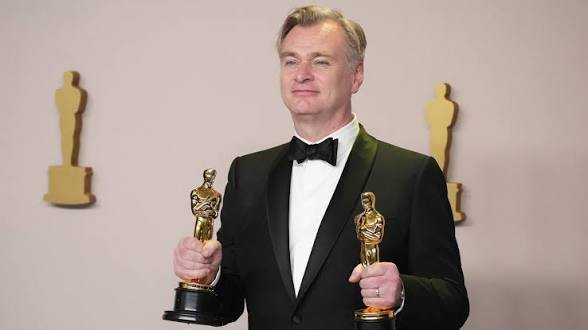
Awards changed his public status without changing the central method. Oppenheimer won seven Academy Awards, including best picture for Thomas, Charles Roven and Nolan, and best director for Nolan. The recognition arrived after decades in which his films had received technical prizes and major commercial success but he had not won those leading categories. In 2024, Britain awarded Nolan a knighthood and Thomas a damehood for their services to film.
Nolan’s humour also complicates his stern reputation. Collaborators often describe dry jokes, teasing and an awareness of the mythology surrounding his methods. He presents serious work seriously, but he does not appear to regard himself as a mystic. His recurring answers return to craft, logistics, audiences and the next problem.
Christopher Nolan remains unusual because his career joins control with dependence. He controls structure, format and production detail, yet he depends on a stable group of producers, actors, technicians and exhibitors. He protects privacy while making films designed for mass discussion. He uses old technology to create images audiences have not seen before. Most importantly, he assumes viewers will concentrate if a film gives them a strong enough reason.