
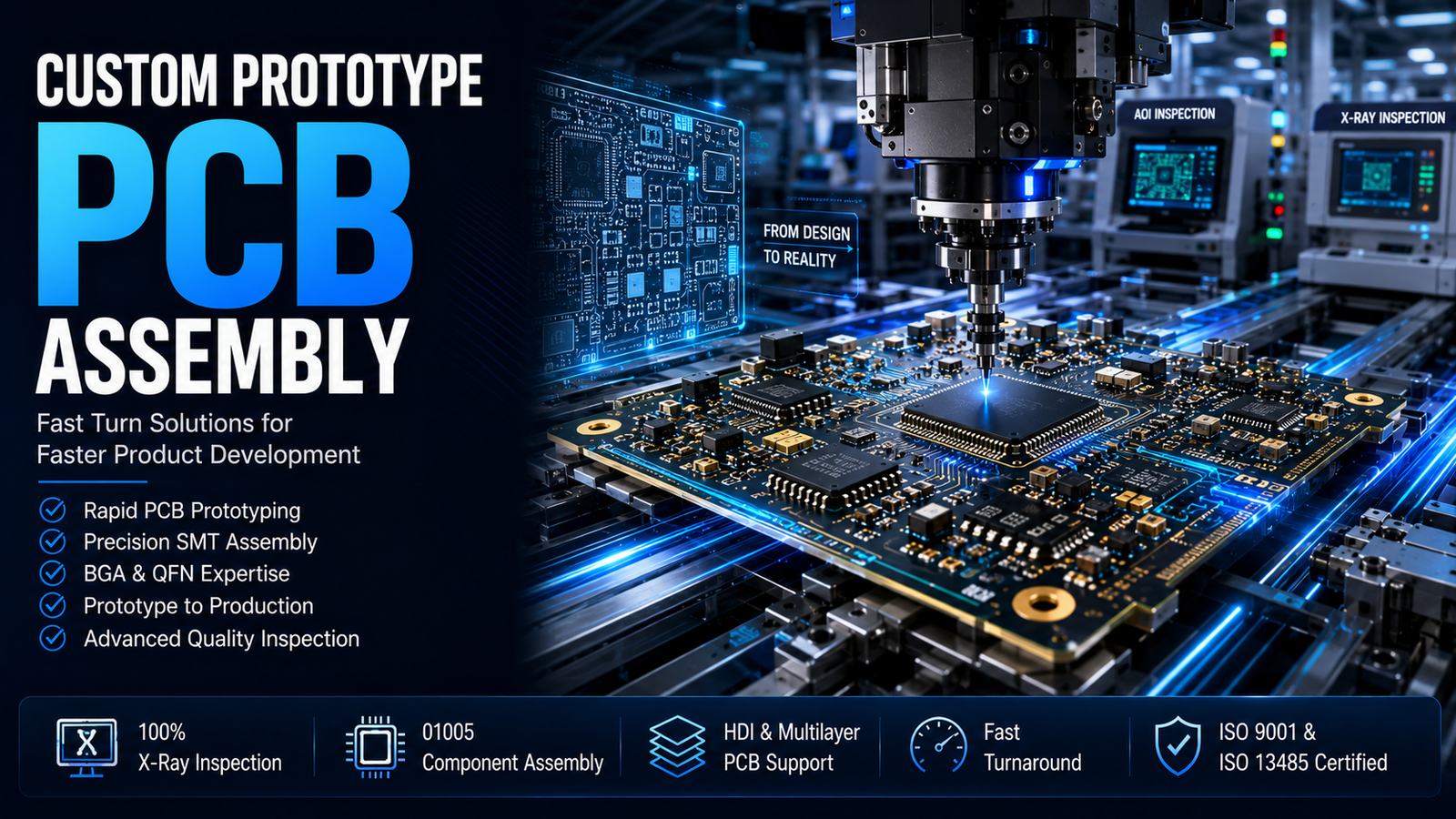
Custom Prototype PCB Assembly: Why Fast Turn PCB Assembly Speeds Up Product Development
Developing a new electronic product takes careful planning, testing, and continuous improvement. Before a design is ready for full production, engineers must verify that every component works correctly and that the circuit board performs as expected. This is why custom prototype pcb assembly plays a critical role in the product development process. A high-quality prototype allows companies to validate designs, identify problems early, and refine the product before committing to production.
As industries such as consumer electronics, medical devices, automotive systems, industrial automation, and telecommunications continue to innovate, the demand for reliable prototype PCB assembly services continues to grow. Choosing the right manufacturing partner helps companies shorten development cycles while maintaining the quality and precision required for today’s advanced electronic products.
What Is Custom Prototype PCB Assembly?
Prototype PCB assembly is the process of assembling electronic components onto a printed circuit board before full-scale manufacturing begins. Unlike production assembly, which focuses on repeatability, throughput, and cost optimization, prototype assembly emphasizes design verification, engineering validation, and rapid iteration.
A successful prototype build allows engineers to:
- Test circuit functionality
- Verify component placement
- Evaluate electrical performance
- Identify design improvements
- Validate manufacturability
- Prepare for production
Building a reliable prototype reduces development risks and provides valuable engineering feedback before volume manufacturing.
Prototype Assembly vs. Production Assembly
Prototype PCBA and production PCBA serve different purposes.
Prototype builds typically involve smaller quantities, frequent engineering changes, and close collaboration between designers and manufacturing engineers. Every build may require design updates or alternate components before the product is finalized.
Production assembly focuses on stable processes, optimized cycle times, and consistent quality across hundreds or thousands of boards after the design has been validated.
A capable manufacturing partner should support the entire development process—from engineering prototypes through production—without losing revision history or manufacturing consistency.
Information Required for a Prototype Build
Accurate documentation is essential for a successful prototype assembly project.
Customers should typically provide:
- Gerber files
- Bill of Materials (BOM)
- Component Placement List (CPL/Centroid file)
- Assembly drawings
- Test files or functional test requirements when available
- Special assembly instructions or programming requirements
Complete documentation helps reduce engineering questions, speeds up production, and minimizes the risk of assembly errors.
Why Prototype Assembly Is Important
Skipping the prototype stage can lead to expensive production delays and product failures. Prototype assembly gives engineers the opportunity to correct problems before moving into full-scale manufacturing.
Major benefits include:
Faster Design Validation
Prototype testing confirms that both the PCB and assembled product function as intended before production begins.
Lower Development Costs
Finding design issues early reduces costly engineering changes later.
Better Product Quality
Prototype evaluation improves long-term reliability by identifying electrical, mechanical, and manufacturing concerns before release.
Reduced Time to Market
A well-tested prototype shortens the path from development to production, allowing products to reach customers sooner.
Engineering Reviews That Improve Prototype Success
Before assembly begins, experienced manufacturers perform several engineering checks to improve manufacturability.
These include:
- Design for Manufacturability (DFM) review
- Design for Assembly (DFA) review
- BOM verification
- Alternate-part approval and control for unavailable components
- PCB footprint validation
- Component orientation verification
These reviews help prevent avoidable manufacturing issues and reduce prototype rework.
Midway through development, many engineering teams choose fast turn pcb assembl because integrating PCB fabrication, component sourcing, engineering review, and assembly through a single manufacturing partner simplifies prototype management, improves communication, and helps maintain rapid turnaround without compromising quality.
Process Control During Prototype Assembly
Prototype assembly requires careful process setup because many products are built for the first time.
Important manufacturing controls include:
- Stencil design optimization
- Controlled solder paste deposition
- Reflow profile development for the specific PCB and component mix
- First Article Inspection (FAI) before full assembly
- Automated Optical Inspection (AOI)
- X-ray inspection for hidden solder joints on packages such as BGAs when required
- In-Circuit Testing (ICT) where applicable
- Functional Circuit Testing (FCT) to verify board operation
These process controls help ensure that engineering prototypes accurately represent the intended production design.
From EVT and DVT to Low-Volume Production
Prototype assembly is often completed in multiple development stages.
Engineering Validation Test (EVT) builds verify the core electrical and mechanical design.
Design Validation Test (DVT) builds confirm that design improvements have been successfully implemented and prepare the product for manufacturing.
Once EVT and DVT are complete, manufacturers can transition smoothly into low-volume production before scaling to full manufacturing.
Maintaining proper revision control throughout these stages ensures that engineering changes are documented and consistently applied across every build.
Certified Manufacturing Standards
Reliable assembly requires internationally recognized quality systems.
Fast Turn PCB operates under:
- ISO9001 certification
- ISO13485 certification
- IPC Class 3 compliance
These standards demonstrate the company’s commitment to producing dependable PCB assemblies for industries where precision and reliability are essential.
Why Engineers Choose Fast Turn PCB
Engineers need more than a contract manufacturer—they need a partner that understands both engineering development and production requirements.
Fast Turn PCB combines experienced engineering teams, integrated PCB fabrication and assembly, comprehensive DFM/DFA support, controlled prototype processes, responsive component sourcing, and rigorous inspection to support projects from initial prototypes through low-volume production and full manufacturing.
Whether developing medical devices, industrial equipment, communication systems, automotive electronics, or consumer products, customers benefit from responsive technical support, efficient engineering collaboration, and consistent manufacturing quality.
Conclusion
Prototype assembly is one of the most important stages of electronic product development. Choosing reliable custom prototype pcb assembly allows engineers to validate designs, reduce development risks, improve product quality, and prepare for successful production.
By combining engineering reviews, controlled assembly processes, comprehensive inspection, effective revision management, and support from EVT and DVT through low-volume manufacturing, Fast Turn PCB provides the expertise needed to accelerate product development while maintaining high standards of quality and reliability.
Visit fastturnpcbs.com today to explore professional PCB assembly solutions and discover how its advanced manufacturing and assembly capabilities can help bring your next electronic product to market faster.